A little over ten years ago I was sitting in an archive when I had a “Eureka” moment. Rewind 103 years to this day in 1917 when an envelope was despatched from France, postmarked Field Post Office D7, 19 No 17, stamped “Passed by Censor” with the signature Wm. Hickie underneath. The writer of the letter inside was also Wm. Hickie and it was private correspondence to a friend.
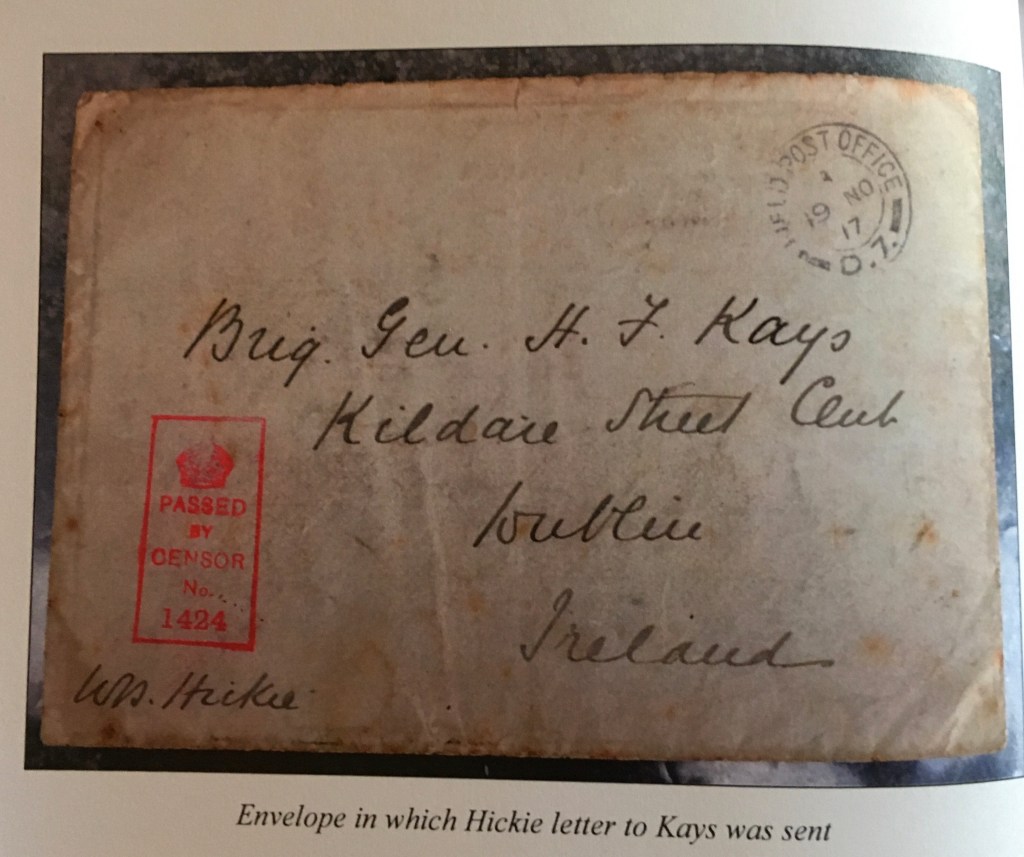
The discovery of this letter was the cause of my moment of euphoria. I had always known of the claimed existence of something like its contents, although I did not know its precise nature, and here it was in front of me.
The letter was written the day before, 18th November 1917, by Major General William Hickie on notepaper embossed Headquarters, 16th (Irish) Division and was sent to a senior army officer on home duty in Ireland. The recipient was Brigadier General Horace Kays and from the way the letter commences it seems that Kays had made a specific enquiry to Hickie. The letter starts, with no preamble:-
“Father Doyle was one of the best priests I have ever met and one of the bravest men who have fought or works out here.”
Later in the letter Hickie says of Father Doyle:-
“He was recommended for the Victoria Cross by his C.O. by his Brigadier and by myself. Superior authority however has not granted it …”
Hickie was the Divisional Commander and one assumes that the recommendation for the VC stopped at either Corps level or above; my own pet theory being at Army level i.e. Fifth Army commander General Sir Hubert Gough.
I was reminded of all this when I saw the recent tweet from @GreatWarGroup about the Victoria Cross, which posed the question: “who have you come across who perhaps was overlooked”. In my biography of Fr Doyle, published in 2013, I said that if retrospective awards could be made for cases overlooked at the time, a good case could be made for the padre. I also sat on the fence regarding whether retrospective awards per se are desirable or not; I said that is another matter. My wider engagement with military history in the intervening seven years leads me to definitely conclude that retrospective awards are not desirable. Nevertheless, it is fascinating to consider the rationale for Major General Hickie’s recommendation – and I am not the first person to have done so.
Fr Willie Doyle’s story features in the historiography (especially Irish) of the Great War. He was killed during Battle of Langemarck, 16th August 1917, trying to retrieve a wounded officer of 8th Royal Dublin Fusiliers from the heat of the battlefield. This was around 3pm, after having marched with the battalion to assemble at the front line in the early hours of the morning for Zero at 4.45 a.m. He then helped, except for a short break, the medics in the Regimental Aid Post situated in shallow gun pits some five hundred yards in front of that assembly line. It was reported that he made forays outside of the RAP to reach the wounded and that, indeed, was how he met his death. The short break was when he and the Medical Officer were ordered to leave the RAP because of the progress of a German counter-attack. However, Fr Doyle returned to the RAP; the M.O. did not.
For the two weeks prior to Zero hour the chaplain had been continuously in front line trenches, declining to leave with the 8th Dubs when they were relieved by 9th Dubs because the 9th Royal Dublin Fusiliers no longer had a padre. Fr Frank Browne (another brave and decorated chaplain, MC and Bar) had been sent back to the Irish Guards and there was no immediate replacement for him.
The day before Fr Doyle died, Fr Frank Browne wrote about his colleague – snippets as follows:-
“Father Doyle is a marvel … I went the other day to see the old Dubs, as I heard they were having – we’ll say, a taste of the war. No one yet has been appointed to take my place and Fr. D has done double work. So unpleasant are the conditions the men had to be relieved frequently. Fr D had no one to relieve him and so he stuck to the mud and the shells, the gas and the terror … The men couldn’t stick it half so well if he weren’t there …the conditions of the ground and air and discomfort surpass anything that I ever dreamt of in the worst days of the Somme.”
The day before that, 14th August 1917, Lieutenant Daniel Galvin of 9th Royal Dublin Fusiliers wrote home with another telling comment:-
“If ever a man earned the VC in this war, it is Father Doyle. He is simply splendid. He comes up every night under heavy shell-fire, burying the dead and binding the wounded and cheering the men. I wish to heavens we had a few doctors like him.”
The Irish writer Myles Dungan quotes a Sergeant Flynn’s letter to the Irish News after Fr Doyle’s death in which he said: “Everybody says that he has earned the VC many times over, and I can vouch for it myself from what I have seen him do many a time”.
There were many other tributes, including this from Lieutenant Colonel H.R. Stirke the Officer Commanding 8th Royal Dublin Fusiliers prior to the Battle of Langemarck, wounded the week previously:-
“He was one of the finest fellows I ever met, utterly fearless … ever ready to go out and attend the wounded and dying under the heaviest fire … rare pluck and devotion to duty … I know that he had been sent back by the O.C. of one of the regiments, together with some other non-combatants, as the fighting was very severe … He only remained behind a few hours and then returned to the fighting line, like the brave man he was.”
Dungan said, but with no reference to the source: “In fact Doyle was recommended for the VC but it was not granted, an omission which reflected no credit whatsoever on those responsible for the decision”.
The subject also exercised Gordon Corrigan in his Mud, Blood and Poppycock book published in 2003, a couple of years before I became interested in Fr Doyle. Major Corrigan indicates how Fr Doyle operated in the front lines, how he had been awarded the Military Cross for actions in 1916 and describes:-
“A quite remarkable man of the cloth was Chaplain Willie Doyle, padre to 8th Battalion the Royal Dublin Fusiliers … a charismatic leader and would probably have been as much at home commanding the battalion as being its spiritual mentor … highly respected and admired by all, whether of his faith or otherwise.”
Corrigan addresses two theories about why this Dubliner, a Jesuit priest, was not awarded the VC, neither of which relate to the actual actions by Fr Doyle in the field. Corrigan points out that Major General Hickie would either have to reject or support a citation for gallantry and, after considering all the available evidence, Corrigan concludes that:-
“Although we may never know for sure, it seems that Father Doyle was never recommended for the Victoria Cross … simply because the criteria for an award were incredibly high”.
Yet, six years after publication of Corrigan’s book, I had in front of me the evidence about the recommendation.
The reason Corrigan, Dungan, and others had either not known about the evidence, or not been able to reference a source for it, is because the letter had been quoted by a Doyle family friend, Alfred O’Reilly, in his biography, but it had never been in the public domain. It is in a family archive.
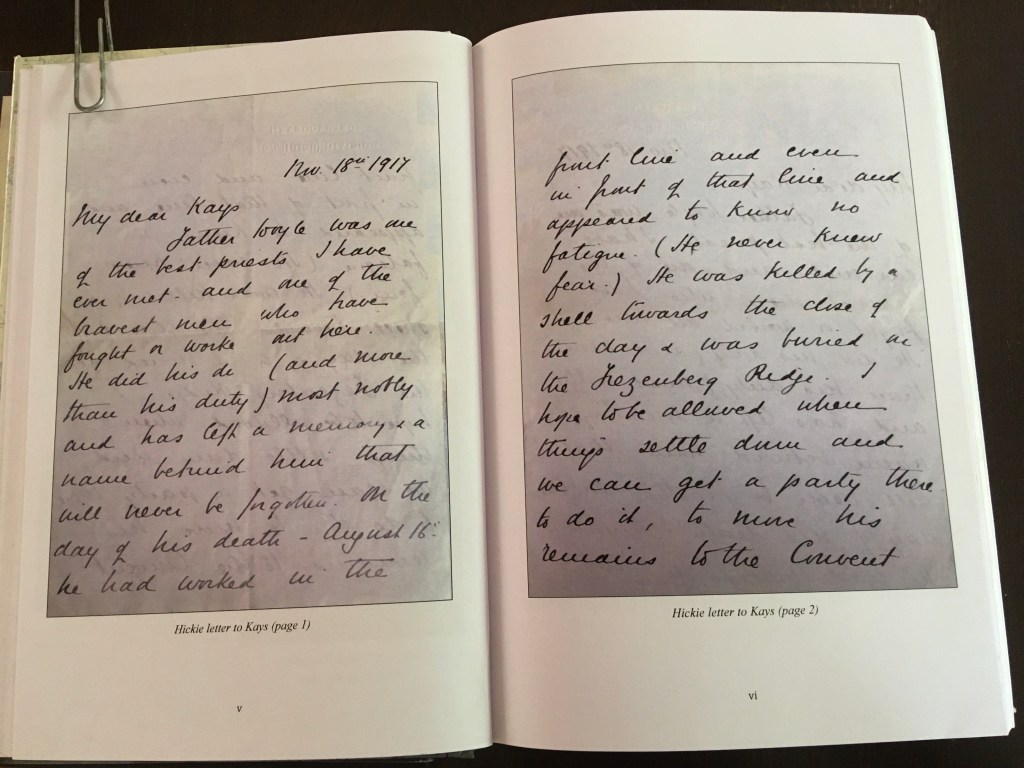
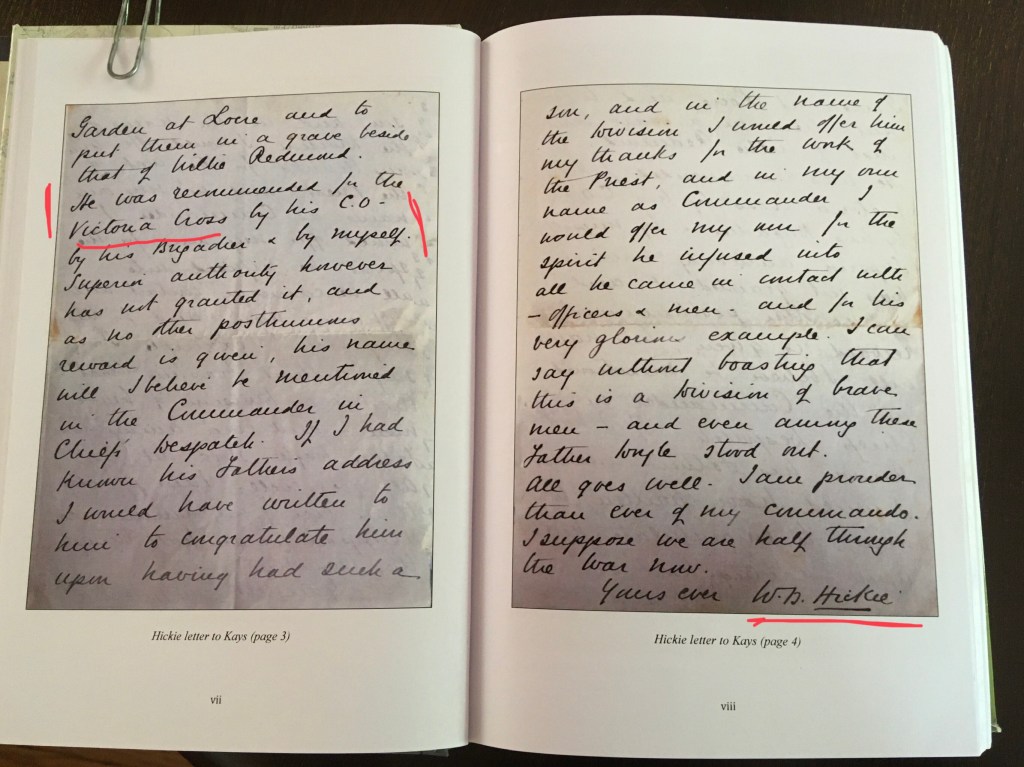
Hickie said Fr Doyle’s Commanding Officer made the recommendation, but who was the C.O.? Although not an attacking battalion of 31st July 1917 (the start of Third Ypres) the 8th Royal Dublin Fusiliers had suffered extensive losses since then owing to its workload, providing burial and working parties and holding the new line of trenches. They were not unique in this, but their losses from wounds, gassing and illness meant that on 16th August, when they were in support, with some men attached to other units, their attacking strength was a little over 80 men. The C.O. of this composite battalion was a newly promoted captain (because of losses), Major George Cowley.
An unknown C.O. (see quote above) ordered the Chaplain and the Medical Officer to return to Headquarters and, shortly afterwards, Major Cowley and his cohort of 8th Dubs moved forward in support of their 48th Infantry Brigade colleagues in the first wave of the attack. Major Cowley was not around when Fr Doyle returned to the Aid Post, neither were any other officers. The witnesses to Fr Doyle’s actions were Corporal Rait holding the Aid Post and other ranks out under fire. Unfortunately, the testimony of NCOs and ORs was not a consideration for the award of a VC, despite it being good enough for the Brigadier and the Divisional Commander.
Did Fr Doyle’s actions on 16th August 1917 conform to the Royal Warrant of 23rd April 1858 that the VC should be for: “conspicuous bravery or devotion to the country in the presence of the enemy”. Some would argue not only, yes, but that his actions during the two weeks prior to that also qualified him, in which case witnesses of the appropriate rank would be able to provide first hand evidence to add weight to the testimony of 16th August.
In 1918 the already decorated (DSO, MC) Rev Fr Theodore Bayley Hardy was awarded the VC for cumulative actions over a period of time in April (5th and 25th/26th of the month). The London Gazette entry of 11the July 1918 commences: “For most conspicuous bravery and devotion to duty on many occasions”.
When Field Marshal Haig visited Fifth Army HQ on 17th August 1917, General Gough told him that he was displeased with the two Irish Divisions of XIX Corps i.e. their part in the disappointing Battle of Langemarck.
There was a Victoria Cross awarded to 16th (Irish) Division for that battle – acting Lance Corporal Frederick Room, a stretcher-bearer of 2nd Royal Irish Regiment, 49th Infantry Brigade. He was from Bristol.
I have drawn my own conclusions about the contents (based on other evidence, obviously) of those last two sentences.
Fr W.J. Doyle has no known grave and is commemorated on the Memorial to the Missing at Tyne Cot, panel 160, Royal Army Chaplains’ Dept. The identity of the officer he was trying to get to safety is one of two young Second Lieutenants, either Charles Marlow or Arthur Green. Both are commemorated on the panel for the Royal Dublin Fusiliers at Tyne Cot.
Note to self: advise Commonwealth War Graves Commission of evidence supporting an amendment to their record of the deaths of Fr Doyle and Second Lieutenants Marlow and Green from 17th August to 16th August 1917. Also, advise Gordon Corrigan and the fact that Fr Doyle’s personal file is at National Archives (it could not be located at the time of his research, but does not reveal anything about the VC issue, although there is other fascinating stuff).
An updated, but scaled back (and that’s not a contradiction of terms) of my biography of Fr Willie Doyle will be published in 2021.

References:-
Irish Voices From The Great War, Myles Dungan, Irish Academic Press, 1995, pages 171-173
Mud, Blood and Poppycock, Gordon Corrigan, Cassell, 2003, pages 101-103
The National Archives T333/1 Victoria Cross including warrants
The National Archives WO 339/123587 personal file of Fr William Doyle, SJ, MC.
Worshipper and Worshipped, Carole Hope, Reveille Press, 2013, various pages!
Transcription of letter:-
Nov 18th 1917
My dear Kays
Father Doyle was one of the best priests I have ever met and one of the bravest men who have fought or works out here. He did his duty (and more than his duty) most nobly and has left a memory and a name behind that will never be forgotten. On the day of his death – August 16th – he had worked in the front line and even in front of that line and appeared to know no fatigue (he never knew fear.) He was killed by a shell towards the close of the day and was buried on the Frezenberg Ridge. I hope to be allowed when things settle down and we can get a party there to do it, to move his remains to the Convent Garden at Locre and to put them in a grave beside that of Willie Redmond.
He was recommended for the Victoria Cross by his C.O., by his Brigadier and by myself. Superior authority however has not granted it, and as no other posthumous award is given, his name I believe will be mentioned in the Commander in Chief’s despatch. If I had known his father’s address I would have written to him to congratulate him upon having had such a son, and in the name of the Division I would offer him my thanks for the work of the Priest, and in my own name as Commander I would offer my own for the spirit he infused into all he came in contact with – officers and men – and for his very glorious example. I can say without boasting that this is a Division of brave men – and even among these Father Doyle stood out.
All goes well. I am prouder than ever of my commands. I suppose we are half through the war now.
Yours ever W.B. Hickie
N.B. My “Eureka!” moment was the first, and possibly the only, time a researcher has had access to the Hickie letter and is a good example of how persistence and good old fashioned letter writing, as well as online methods, can produce results.

 Great War Old Gal